
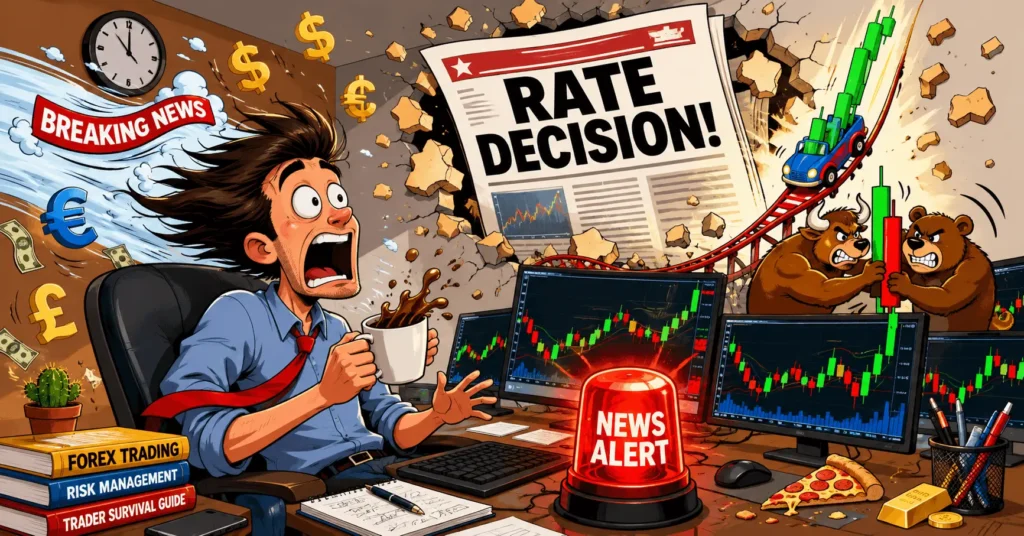
News impact on forex can happen in less than sixty seconds. A central bank governor says one sentence differently than expected, and a currency pair that had been trading in a tight 20-pip range all morning suddenly rips through 100 pips before most traders even finish reading the headline. Spreads widen, stop losses get triggered in a cascade, and by the time the dust settles, the technical chart from an hour ago looks almost irrelevant.
This is the reality of forex trading: no chart pattern, no moving average, and no support level is immune to the impact of news. If you trade currencies — or you’re thinking about starting — understanding how news moves the market isn’t optional. It’s the difference between being blindsided by volatility and knowing exactly when to step back, and when to step in.
This guide breaks down why forex reacts the way it does to news, the specific categories of events that move the market most, and how traders actually position around them.
Why Forex Reacts So Strongly to News
Forex is the largest and most liquid financial market in the world, trading nearly 24 hours a day, five days a week. That liquidity is exactly why it reacts so fast — there’s no shortage of buyers and sellers ready to reprice a currency the instant new information hits the wire.
But there’s a second reason forex is uniquely sensitive to news: currencies are always priced in pairs. A move in the US dollar isn’t just about the US economy — it’s about the US economy relative to the eurozone, Japan, or the UK. That means a single piece of data can simultaneously shift two economic outlooks at once, doubling its effective news impact on forex price movements.
It’s also worth understanding that markets rarely react to the news itself — they react to the surprise. Traders and institutions constantly price in expectations ahead of a release. When the actual number matches the forecast, the reaction is often muted. When it deviates significantly, that gap between expected and actual is what triggers the sharp, fast repricing you see on the chart.
The Types of News That Move Currency Markets Most
Not all news carries equal weight. Some categories consistently produce outsized volatility, while others barely register outside of niche pairs.
Central bank decisions and statements tend to be the single biggest market-moving events in forex. Interest rate decisions from the Federal Reserve, European Central Bank, or Bank of England shift the relative return on holding a currency, and the accompanying press conference or forward guidance often moves price more than the rate decision itself.
Employment data, especially the US Non-Farm Payrolls (NFP) report, is famous among forex traders for triggering some of the sharpest short-term volatility of any monthly release. Wage growth and unemployment claims data carry similar, if smaller, effects.
Inflation reports, such as the Consumer Price Index (CPI) and Producer Price Index (PPI), directly influence expectations of future central bank policy, which makes them highly reactive events in their own right.
GDP and broader growth data shape longer-term sentiment about an economy’s trajectory, generally producing steadier but still meaningful moves.
Geopolitical events — elections, trade policy shifts, sanctions, or armed conflict — can move currencies unpredictably and are harder to price in advance, which is part of why they often cause outsized reactions.
Risk sentiment events, like banking sector stress or unexpected financial shocks, tend to trigger broad “risk-off” moves where traders flee toward traditionally safe-haven currencies — a clear example of the news impact on forex during periods of global uncertainty.
Reading an Economic Calendar Like a Trader
Every serious forex trader keeps an economic calendar open. These calendars flag upcoming releases with an impact rating — typically high, medium, or low — based on how much historical volatility that event type tends to generate.
The number that matters most isn’t the raw data point on its own — it’s the relationship between three figures: the forecast (what economists expected), the previous reading, and the actual result once released. A large gap between forecast and actual is usually what triggers a sharp move, regardless of whether the number itself sounds impressive — a simple but powerful illustration of news impact on forex price behavior.
What Actually Happens to Price During a News Release
In the minutes leading up to a high-impact release, price action often tightens into a narrow range as traders wait on the sidelines. Then, the moment the data hits, liquidity can briefly evaporate, spreads widen, and price can spike and whipsaw in both directions before settling into a clearer trend.
This is also when slippage becomes a real risk — the price you intended to trade at and the price your order actually fills at can differ meaningfully during the first few seconds after release. Once the initial volatility settles, the market often either continues in the direction of the surprise or reverses sharply as early positioning gets unwound.
Trading Strategies Around News Events
There are three broad approaches traders take toward news volatility, and none is universally “correct” — it depends on risk tolerance and experience level.
Trading the release directly means entering a position in the seconds or minutes after the data drops, aiming to capture the initial momentum. This can be highly profitable, but it also carries the highest risk due to slippage and unpredictable spread widening.
Trading the retracement is a more measured approach: letting the initial spike play out, then entering once price pulls back and a clearer direction emerges.
Avoiding the news window entirely is a common choice for swing and position traders, who close or reduce exposure ahead of major releases simply to sidestep the noise altogether.
Whichever approach you choose, risk management around news events should look different from a normal trading session — that typically means wider stop losses, smaller position sizes, and strict avoidance of excessive leverage during the release window.
Common Mistakes Traders Make With News Trading
The most frequent error is leverage that’s sized for calm markets but held through a volatile release. Others include ignoring the true cost of slippage and widened spreads, assuming a single data point confirms a long-term trend when it may just be noise, and revenge trading immediately after a stop-out — chasing the same move a second time without a clear setup.
A Real Example: The Power of a Single Data Surprise
High-impact US employment and inflation releases have repeatedly demonstrated the news impact on forex when actual data diverges sharply from forecasts. Pairs like EUR/USD and GBP/USD have, on multiple occasions, moved well over 100 pips within minutes of a major surprise — a scale of movement that could otherwise take days to unfold on a quiet technical chart. It’s a useful reminder that an economic calendar deserves the same attention as any indicator on your trading platform.
FAQ: News Impact on Forex
What is the most impactful forex news event?
Central bank interest rate decisions and US Non-Farm Payrolls are widely considered the two most consistently volatile events in the forex calendar.
How long does news volatility last in forex?
The sharpest volatility usually plays out within the first 5-30 minutes after a release, though elevated price movement and trending behavior can continue for hours or even the rest of the trading session.
Should beginners trade during news releases?
Most experienced traders recommend beginners avoid trading directly through high-impact news until they’ve built experience managing slippage, wider spreads, and fast-moving price action.
How do I find upcoming high-impact forex news?
Free economic calendars from sites like ForexFactory and Investing.com list upcoming releases along with their historical impact rating, forecast, and previous figures.
Final Thoughts
News doesn’t just move currency prices — it moves the expectations that prices are built on. Understanding which events matter, why the surprise matters more than the number itself, and how to manage risk around volatility isn’t a side skill for forex traders — it’s a core one. The traders who consistently navigate news-driven markets aren’t the ones predicting headlines; they’re the ones who respect the calendar and plan for it every single time.