
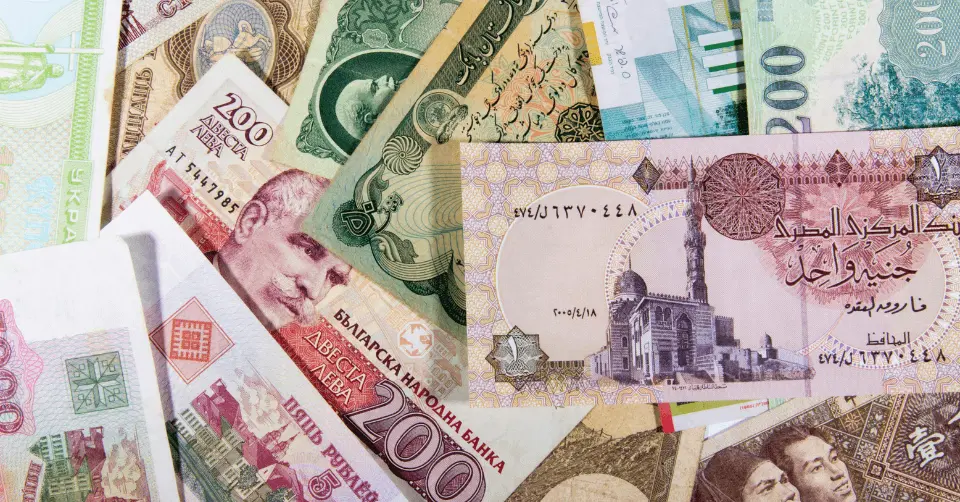
What is Forex? It is the global market where currencies are bought and sold. It affects everyday activities—like exchanging money for a trip abroad—and global forces, such as trade flows and central bank policy. Forex is also the largest financial market by volume, offering high liquidity and continuous trading opportunities across time zones. This guide explains what Forex is, how it works, who participates, and how someone new can get started.
How Forex works — the basics you should know
Forex always involves two currencies traded as a pair. The first currency (the base) is priced in terms of the second (the quote). For example, EUR/USD = 1.10 means 1 euro costs 1.10 U.S. dollars. Every Forex trade simultaneously buys one currency and sells another.
Key features:
- No single exchange: Forex is an over-the-counter (OTC) market—trades happen electronically through banks, brokers, and platforms rather than on a single exchange.
- High liquidity: Major pairs (those including the USD, EUR, JPY, GBP, etc.) have tight spreads and easy order execution.
- Near-24/5 trading: Forex runs almost round-the-clock on business days, offering flexibility and continuous price discovery.
A short history in context
Currency exchange has long roots—merchant trade required converting coins and goods across borders (Source). In the 20th century the international system shifted through major stages: the Gold Standard, then the post-war fixed-rate system established at the Bretton Woods, and finally the modern floating-rate era that began in the early 1970s. The internet and retail brokers later opened Forex to individual traders, alongside banks and institutions.
Who participates in Forex
The market moves because many different players act with different goals. Main participants include:
- Central banks — set interest rates and intervene in extreme cases.
- Commercial and investment banks — provide liquidity and execute large flows.
- Hedge funds & institutional traders — speculate or hedge large positions.
- Corporations — manage currency risk from imports, exports, and global operations.
- Retail traders — individuals trading through brokers and platforms.
- Brokers & market makers — quote prices and enable market access.
Types of currency pairs and how to read them
Currency pairs are grouped to show liquidity and risk:
- Major pairs: EUR/USD, GBP/USD, USD/JPY — highest liquidity and narrow spreads.
- Minor pairs (crosses): EUR/GBP, AUD/CAD — no USD involvement, slightly wider spreads.
- Exotic pairs: USD/TRY, EUR/ZAR — larger spreads, higher volatility.
Reading a pair like GBP/USD = 1.30 means 1 British pound buys 1.30 U.S. dollars.
Core trading concepts
- Long vs. Short: “Long” = buy expecting the base currency to appreciate; “Short” = sell expecting depreciation.
- Pip: The standard unit of price movement (often 0.0001). Learn how to calculate it with our Pip Value Calculator.
- Lot sizes: Standard, mini, micro — determine trade volume.
- Leverage: Borrowed exposure from the broker—amplifies profits and losses. Use tools like a Stop-Loss to manage risk effectively.
- Bid / Ask / Spread: Bid = price buyers pay, Ask = price sellers accept, Spread = difference (cost of trading).
Market hours and sessions
Forex follows global business hours—activity shifts by region and session. Major sessions are:
- Sydney — start of Asia-Pacific trading. Sydney
- Tokyo — Asian liquidity and price action. Tokyo
- London — major European liquidity and volatility center. London
- New York — U.S. session; overlaps with London for peak volume. New York
The London–New York overlap typically produces the highest liquidity and largest moves.
What moves exchange rates
Exchange rates respond to macroeconomic and political factors, for example:
- Central bank interest rate decisions and monetary policy
- Inflation, GDP, and employment reports
- Geopolitical events (elections, sanctions, conflicts)
- Trade balances and capital flows
- Market sentiment and speculative positioning
Watching an economic calendar and major news releases is essential because news often causes sharp, rapid price changes.
Common trading styles (pick one that fits you)
- Scalping: very short-term, frequent trades (seconds–minutes).
- Day trading: open/close within a day, avoids overnight risk.
- Swing trading: hold for days to weeks to capture trends.
- Position trading: long-term, based on macro views (weeks–months).
Choose a style based on available time, psychological fit, and risk tolerance.
Advantages and drawbacks of Forex trading
Advantages
- Extremely high liquidity and many trading opportunities
- Ability to trade both rising and falling markets
- 24/5 market access for flexible schedules
Drawbacks
- Leverage increases the chance of large losses
- Requires discipline, education, and risk management
- Market-moving players (big banks, institutions) can dominate price action
Practical steps to get started
- Learn the basics: read quality material and follow economic news.
- Choose a regulated broker: verify licensing and client protections.
- Open a demo account: practice strategy and platform use with virtual funds.
- Develop a trading plan: define entry, exit, stop-loss, position size, and rationale.
- Start small on live account: trade only capital you can afford to lose.
- Use risk controls: position sizing, stop-losses, and consistent journaling.
Mistakes to avoid
- Over-leveraging positions without a plan
- Trading impulsively or chasing losses
- Skipping demo practice and jumping straight into live funds
- Ignoring risk management tools and position sizing
Is Forex right for you?
Forex suits people who want a market with high liquidity, 24/5 access, and the ability to trade both directions. It demands time for study, emotional control, and consistent risk management. Treat Forex as a skill to develop: plan, practice, and improve gradually rather than expecting quick riches.
Final takeaway
Forex is the engine of global currency exchange and a major financial market in its own right. Learning the mechanics—pairs, sessions, participants, and the economic drivers—along with disciplined risk management and practice, gives you the foundation to participate intelligently. Start with education and a demo account, design a simple trading plan, and scale only after you have consistent proof of your method.