
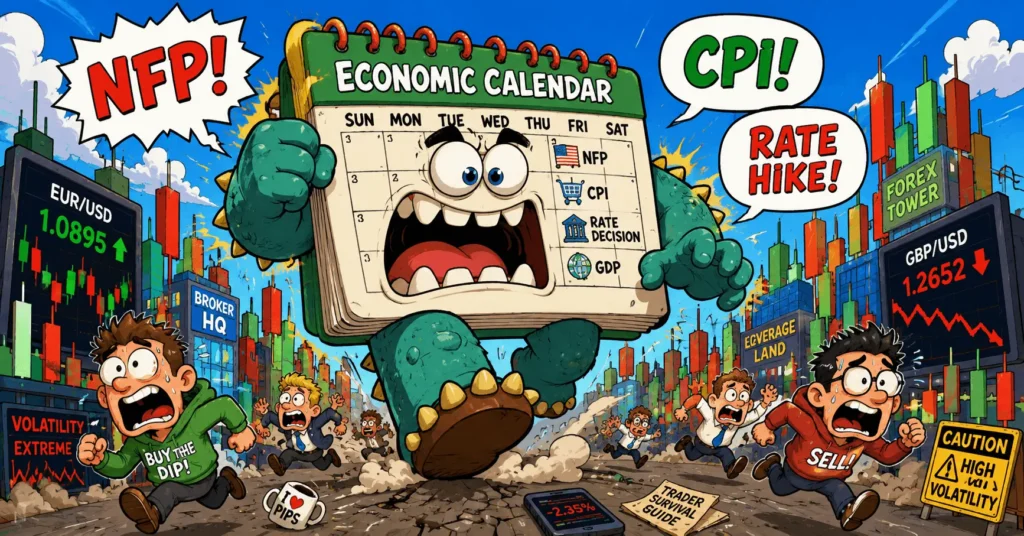
The economic calendar is one of the most essential tools any forex trader can use. Every week, governments and central banks release key economic indicators — employment data, inflation reports, interest rate decisions, and GDP figures — that directly move currency prices, often within seconds of release.
Whether you are a beginner trying to avoid unexpected losses during volatile releases, or an experienced trader looking to plan entries around high impact forex events, this forex economic calendar gives you everything in one place — what is coming, when it drops, what the market expects, and what actually happened — updated automatically, every week.
What Is an Economic Calendar?
An economic calendar is a schedule of planned economic data releases and events that are expected to impact financial markets. It lists the date, time, affected currency, expected market impact, and the forecast figure for each release.
Traders use a forex news calendar to prepare for the week ahead. By knowing which economic events are scheduled and how significant they are, you can make smarter decisions about when to enter trades, when to stay out, and when to manage your open positions more carefully.
How to Use This Economic Calendar
Filter by Impact Level The first thing to do is filter by impact. High impact forex events — shown in red — are the ones that historically cause the largest price movements. If you are new to trading the news, start by watching only High impact releases. This keeps things simple and teaches you how the market reacts to major data.
Filter by Currency If you trade EUR/USD, filter the forex economic calendar to show only EUR and USD events. There is no point tracking Japanese or Australian economic events if those currencies are not in your trade. Filtering by currency saves time and keeps your focus sharp.
Understand the Three Numbers Every event in the economic calendar shows three key figures. The Previous is the last reading. The Forecast is what analysts expect. The Actual is the number released. The bigger the gap between Forecast and Actual, the bigger the potential market reaction. This is the core of trading the news.
Plan Your Week in Advance Check the forex news calendar every Monday morning before the market opens. Mark all the High impact events on your chart. Decide in advance whether you will avoid trading around those times or prepare to trade the volatility they create.
Why Every Forex Trader Needs an Economic Calendar
Most traders focus heavily on technical analysis — chart patterns, indicators, support and resistance levels. But even the most perfectly set up trade can fail instantly if a major economic indicator release surprises the market. The economic calendar is what protects you from that.
Avoid Being Caught Off Guard High impact forex events like Non-Farm Payrolls or interest rate decisions can move price by 50 to 150 pips in a matter of seconds. Spreads widen, liquidity thins, and stop losses get hunted. None of that should be a surprise — the economic calendar tells you exactly when it is coming.
Trade the News Intentionally When the Actual figure significantly beats or misses the Forecast, currency markets react sharply and often predictably. Experienced traders use the forex economic calendar to position in advance or to wait for the spike to settle before entering in the direction of the surprise.
Understand the Macro Story Interest rate decisions from the Federal Reserve, European Central Bank, Bank of England, and Bank of Japan are the single biggest long-term driver of currency trends. By following economic events consistently through a forex news calendar, you start to understand why currencies move the way they do — and that makes you a far better trader over time.
Key Economic Indicators Explained
Not all events carry the same weight. Here are the most important economic indicators to track in any forex economic calendar.
Non-Farm Payrolls (NFP) Released on the first Friday of every month, Non-Farm Payrolls measure the number of new jobs added to the US economy. It is the single most watched release for USD pairs and almost always causes a major spike at release time.
CPI — Consumer Price Index CPI measures inflation. Central banks watch it closely because high inflation forces them to raise interest rates to cool the economy, which strengthens the currency. A higher than expected CPI reading is typically bullish for that currency.
Interest Rate Decisions Interest rate decisions from major central banks — the Fed, ECB, BOE, BOJ, RBA — are the highest impact economic events on the economic calendar. Even when rates are held unchanged, the accompanying statement and press conference can move markets significantly.
GDP — Gross Domestic Product GDP measures the total value of goods and services produced by an economy. Strong GDP growth signals a healthy economy and tends to be positive for the currency. GDP figures are released quarterly and are a key economic indicator for long-term fundamental traders.
PMI — Purchasing Managers Index PMI surveys are released monthly and measure business activity in the manufacturing and services sectors. A reading above 50 signals expansion. Because PMI data comes out before most other monthly figures, it is one of the more useful leading economic indicators in the forex news calendar.
Impact Levels — What They Mean
Every event in this economic calendar is rated by its expected impact on the market.
High Impact — These high impact forex events have historically moved the market significantly. Treat these with respect. Consider reducing position size, tightening stops, or standing aside entirely before the release.
Medium Impact — These events can cause short-term spikes, especially if the Actual deviates significantly from the Forecast. Worth knowing about but not always a reason to change your trading plan.
Low Impact — These economic events rarely move the market. Safe to trade around in most cases.
Example: Reading the Calendar in Action
It is a Friday morning. You open the forex economic calendar and see that Non-Farm Payrolls are due at 1:30 PM EST. The Forecast is 185,000 new jobs. The Previous reading was 177,000.
At 1:30 PM, the Actual comes in at 227,000 — a massive beat. USD strengthens immediately. EUR/USD drops 80 pips in under a minute. Traders short on USD going into the release take heavy losses. Traders who saw the beat and bought USD on the breakout captured significant profit.
This is exactly why checking the economic calendar before every trading session is a non-negotiable habit for serious forex traders.
Frequently Asked Questions
What is an economic calendar used for?
An economic calendar is used by forex traders to track scheduled economic events that are likely to move currency markets. It shows the release time, affected currency, expected impact level, and forecast versus actual figures.
Which economic events move the market the most?
The high impact forex events that consistently cause the biggest price movements are Non-Farm Payrolls, CPI inflation data, interest rate decisions, and central bank press conferences.
What is the difference between Forecast and Actual?
The Forecast is what economists expect the economic indicator to show. The Actual is the real number released. The bigger the gap between the two, the bigger the likely market reaction.