
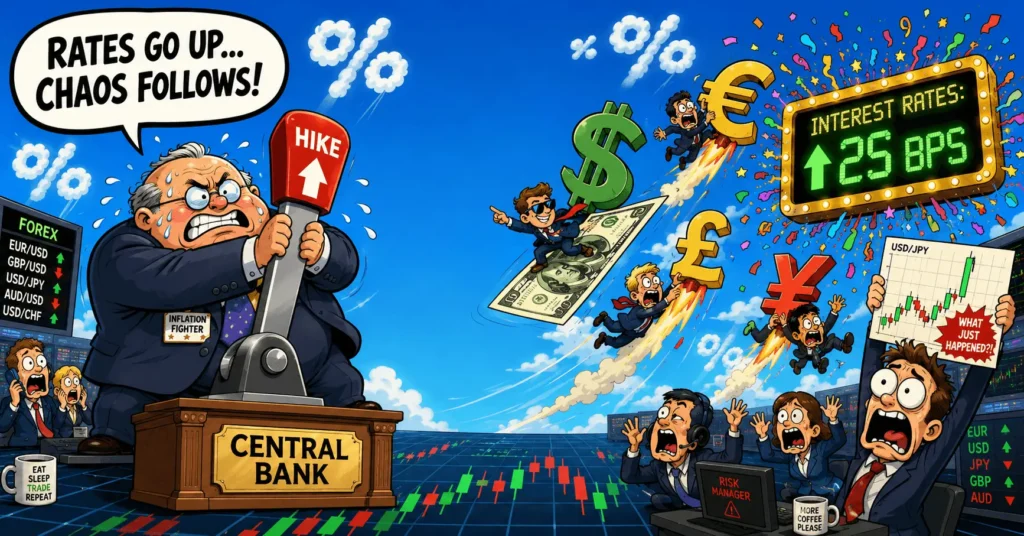
If you have ever watched a currency pair spike 200 pips in minutes with no obvious chart signal, chances are a central bank just moved rates — or signaled it was about to. Interest rates in forex trading are not a background variable. They are the engine. Everything else — inflation data, GDP reports, employment figures — feeds into one question the market is always asking: where are rates going next?
This guide breaks down exactly how interest rates work in the forex market, why monetary policy decisions move currencies more than almost any other force, and how you can use this knowledge to trade with the trend rather than against it.
What Are Interest Rates in Forex Trading and Why Do They Matter?
An interest rate is the cost of borrowing money, set by a country’s central bank. In the United States, that is the Federal Reserve. In Europe, it is the European Central Bank (ECB). These institutions meet regularly to decide whether to raise, cut, or hold their benchmark rate — and forex markets move on every word they publish.
Here is the core logic: when a country raises interest rates, its bonds and savings instruments offer higher returns. That attracts foreign investors who need to buy that country’s currency first to invest. More demand for the currency means the price goes up. When rates fall, the reverse happens — capital flows out and the currency weakens.
It sounds simple. The execution is where it gets nuanced.
Monetary Policy: The Framework Behind Every Rate Decision
To trade interest rates properly, you need to understand what monetary policy is and how central banks use it.
Monetary policy is the set of tools a central bank uses to control money supply, manage inflation, and stabilize the economy. The primary tool is the benchmark interest rate. Raise it and you cool economic activity, slow inflation, and strengthen the currency. Cut it and you stimulate growth, accept more inflation, and typically weaken the currency.
Central banks publish a monetary policy report several times per year. These documents lay out the bank’s economic assessment, inflation forecast, and forward guidance on rates. Traders read them carefully — not just for what the bank decided, but for the language used. Words like “remaining restrictive” or “data dependent” carry significant market weight because they signal future rate direction before it happens.
The two dominant institutions forex traders track are:
- Federal Reserve monetary policy — Governs the USD, the world’s reserve currency. FOMC meetings and Fed Chair press conferences regularly produce the highest-volatility events in the forex calendar.
- ECB monetary policy — Governs the EUR. The ECB’s decisions directly drive EUR/USD, EUR/GBP, and most European cross pairs.
Inflation: The Trigger That Forces Central Banks to Act
Central banks do not move rates arbitrarily. Inflation is almost always the trigger.
When inflation rises above a central bank’s target — typically 2% for most developed economies — the bank faces pressure to hike rates to cool spending and bring prices down. Traders watch inflation data (CPI, PCE, PPI) religiously because a surprise inflation print often reprices rate expectations within seconds of release.
Consider what happened across 2022 and 2023. US inflation surged to 40-year highs. The Federal Reserve responded with the most aggressive hiking cycle in decades, lifting rates from near zero to above 5%. The result: the US Dollar Index (DXY) surged to 20-year highs. Traders who understood the inflation-to-rate-hike transmission made some of the cleanest directional trades of the decade.
The lesson: do not just trade the rate decision. Trade the inflation data that predicts it.
Fiscal Policy vs Monetary Policy — Know the Difference
A common mistake among newer traders is conflating fiscal policy and monetary policy. They are related but distinct.
Monetary policy is controlled by the central bank. It uses interest rates and tools like quantitative easing or tightening to influence the money supply and inflation. The central bank is (in most developed economies) independent of government.
Fiscal policy is controlled by the government. It involves taxation and government spending decisions. Large fiscal deficits can pressure a currency if markets question a country’s debt sustainability — but fiscal policy moves slowly and rarely triggers the immediate volatility that a rate decision does.
In forex trading, monetary policy is your primary focus. Fiscal policy matters as a backdrop — particularly for emerging market currencies — but the rate-setting decisions of the Federal Reserve or ECB will almost always dwarf any fiscal announcement in terms of short-term market impact.
Interest Rate Differentials: The Real Driver of Currency Pair Direction
You do not trade interest rates in isolation. You trade the differential — the gap between two countries’ rates.
A currency pair is, by definition, a comparison between two economies. EUR/USD is not just about the ECB or just about the Fed. It is about which central bank is more hawkish relative to the other. When the Fed is hiking and the ECB is holding, the interest rate differential widens in the dollar’s favour — and EUR/USD trends lower. When the ECB catches up or the Fed pivots, the differential narrows and the pair reverses.
This is why professional traders build a currency strength matrix at the start of each week: ranking G10 currencies by their central bank’s current stance, recent rate path, and forward guidance. The pair with the widest divergence in rate expectations is often the cleanest trade.
How to Use This in Your Trading
Three practical steps to apply interest rate analysis:
Step 1 — Track the rate expectations, not just the current rate. Use tools like the CME FedWatch Tool to see what probability the market is pricing in for future Fed rate moves. Markets price months ahead. If a hike is already 95% priced, the currency may not move much when it happens.
Step 2 — Read every monetary policy report statement. The language shift from “we may need to hike further” to “we are in a position to hold” is a trend change signal. Act on the language, not just the numbers.
Step 3 — Combine with technical structure. Fundamental rate bias tells you direction. Technical levels tell you where to enter. A hawkish Fed gives you a USD buy bias — a technical pullback to a key support level on USD/JPY gives you the entry point.
Final Word
Interest rates in forex trading are not a specialist topic reserved for macroeconomists. They are the foundation every serious forex trader needs to understand. Know what monetary policy is, follow the Federal Reserve and ECB monetary policy decisions closely, watch inflation as the leading indicator, and track rate differentials to identify directional bias on your pairs.
The market is always pricing the next rate move. Your job is to figure out what that is before the majority does.