
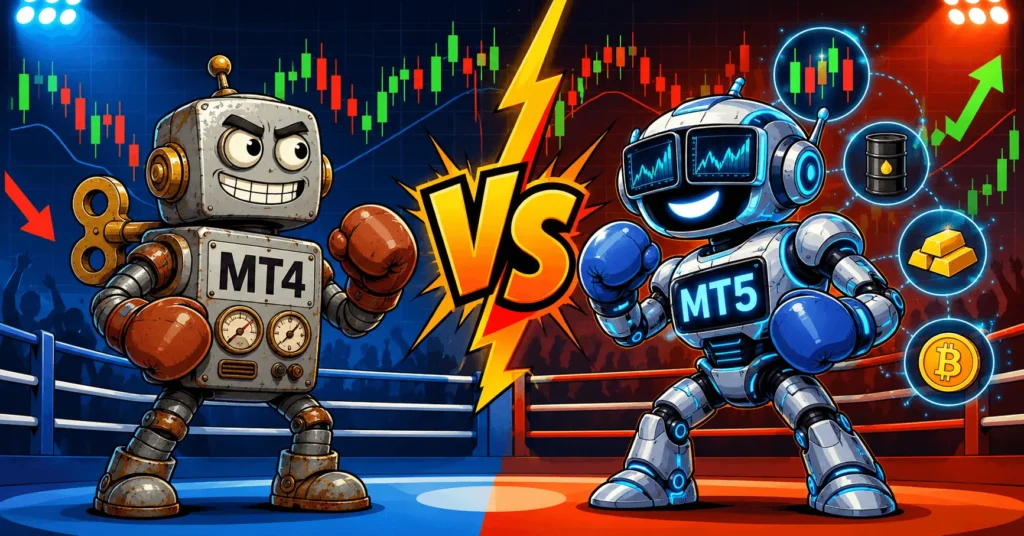
The MT4 Vs MT5 debate has followed traders for more than a decade, and in 2026 it still hasn’t been fully settled. MetaTrader 5 now handles the majority of retail trading volume worldwide, yet MetaTrader 4 remains active in thousands of trading accounts and broker platforms. So the real question isn’t which platform is newer — it’s which one actually fits the way you trade.
This guide breaks down the practical differences between the two so you can make that call with confidence.
What Is MT4?
MetaTrader 4 launched in 2005 and quickly became the default platform for retail forex trading. It was built specifically for currency trading and CFDs, with a simple interface, reliable order execution, and a scripting language (MQL4) that let traders build their own indicators, scripts, and Expert Advisors (EAs). That openness created a massive third-party ecosystem — free tools, custom indicators, and automated strategies that are still widely shared today. Two decades later, MT4 remains popular precisely because it does one job well and rarely changes.
What Is MT5?
MetaTrader 5 arrived in 2010 as MetaQuotes‘ answer to a changing market. Rather than focusing on forex alone, MT5 was designed as a true multi-asset platform, capable of handling stocks, futures, commodities, indices, and crypto CFDs from a single account. It runs on MQL5, a more modern and efficient programming language, and was intended to eventually replace MT4 altogether. That replacement never fully happened — but MT5 has steadily become the platform of choice for new brokers and traders building strategies from scratch.
MT4 Vs MT5: Key Differences at a Glance
| Feature | MT4 | MT5 |
| Release year | 2005 | 2010 |
| Asset classes | Forex, CFDs | Forex, stocks, futures, commodities, indices, crypto CFDs |
| Timeframes | 9 | 21 |
| Pending order types | 4 | 6 (adds Buy/Sell Stop Limit) |
| Programming language | MQL4 | MQL5 |
| Architecture | 32-bit | 64-bit |
| Strategy Tester | Single-threaded | Multi-threaded, real tick data |
| Depth of Market | No | Yes |
| Built-in economic calendar | No | Yes |
| Ongoing development | Maintenance mode | Active updates |
On paper, MT5 leads in almost every technical category. But that doesn’t automatically make it the right choice for every trader — context matters, which is why the sections below go deeper on the differences that actually affect day-to-day trading.
Execution Speed and Backtesting
For manual traders, the execution gap between MT4 and MT5 is barely noticeable. For algorithmic traders, it’s significant. MT5’s Strategy Tester distributes backtesting across multiple processor cores, so a test that takes minutes on MT4 can finish in seconds on MT5. It also uses real historical tick data rather than interpolated ticks, producing a far more accurate picture of how an EA would have performed live. MT5 additionally supports multi-currency backtesting, letting traders test correlated pairs together instead of running and manually stitching together separate reports. If you’re developing or refining automated strategies, this is one of the clearest reasons to work in MT5.
Which Platform Should You Choose?
There’s no universally “correct” answer in the MT4 Vs MT5 comparison — the right platform depends on your trading style.
Choose MT4 if:
- You trade forex exclusively and don’t need other asset classes
- You rely on a specific library of MT4 Expert Advisors or indicators
- Your broker doesn’t yet offer full MT5 support
Choose MT5 if:
- You trade or plan to trade stocks, futures, commodities, or indices alongside forex
- You’re building new EAs and want faster, more accurate backtesting
- You want a platform that continues to receive updates and new features
Many active traders and brokers now run both platforms side by side — MT4 for legacy strategies and familiarity, MT5 for growth and multi-asset access. This dual approach isn’t a compromise; it’s increasingly the norm in 2026.
Is MT4 Being Discontinued?
Not immediately, but its direction is clear. MetaQuotes still maintains MT4 with security patches and bug fixes, and brokers continue renewing their licenses. However, all new feature development is going into MT5. In practical terms, MT4 is in maintenance mode — stable and supported, but not evolving. Traders who build long-term strategies or plan to scale into other markets should treat this as a signal to at least get familiar with MT5, even if they’re not ready to fully switch.
Final Thoughts
The MT4 Vs MT5 decision comes down to one question: are you trading forex only, or building toward something broader? MT4 still delivers a fast, dependable experience for pure forex traders. MT5 offers more markets, faster backtesting, and a platform MetaQuotes is actively investing in. Whichever you choose, understanding these differences up front will save you a migration headache later.