
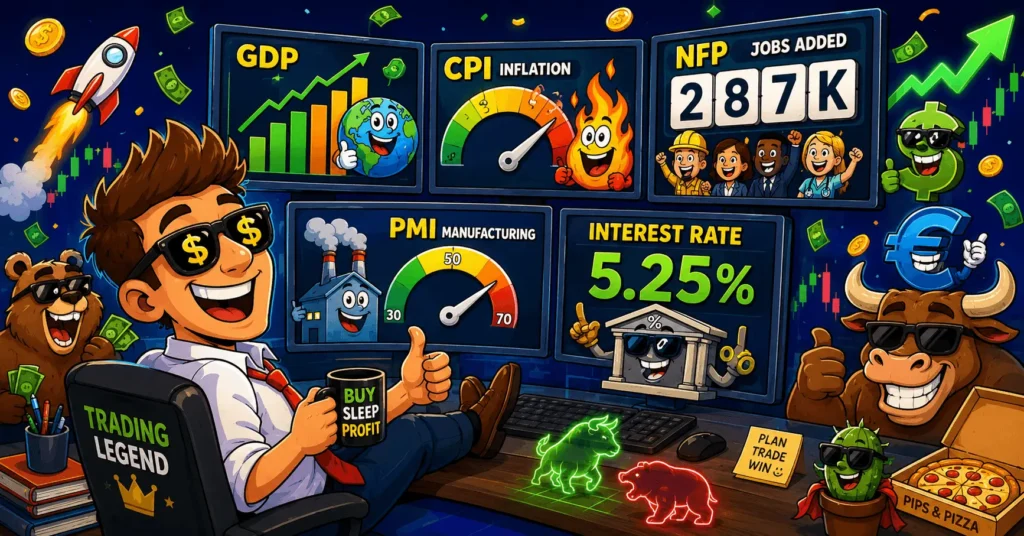
Most traders spend hours studying chart patterns, perfecting entries, and tweaking their risk management — which is all valid. But if you’re ignoring economic indicators, you’re essentially trading with half the picture. A single data release can obliterate a clean technical setup in seconds. Understanding what drives those moves? That’s where real edge lives.
This guide breaks down economic indicators in plain terms — what they are, which ones actually move markets, and how to use them without getting caught on the wrong side of a news release.
What Are Economic Indicators?
Economic indicators are data points released by governments, central banks, and research institutions that measure the health and direction of an economy. Think of them as vital signs — pulse rate, blood pressure, temperature — but for a country’s financial system.
For traders and investors, these numbers matter because markets are fundamentally forward-looking. Prices don’t just reflect what’s happening now; they reflect what people expect to happen. When an economic indicator surprises — either to the upside or downside — it forces the market to reprice that expectation fast. That repricing is volatility. And volatility is opportunity.
The 3 Types of Economic Indicators
Not all indicators carry the same weight or timing. They fall into three categories:
Leading Indicators signal what’s likely to happen before it actually does. They’re the most valuable for traders because they offer a forward look. Examples include stock market performance, consumer confidence surveys, and building permits.
Lagging Indicators confirm what has already happened. They’re useful for validating a trend but don’t help you get in early. Unemployment rate and corporate earnings are classic examples — they reflect economic conditions that already played out.
Coincident Indicators move in real time with the economy. They tell you what’s happening right now. GDP and industrial production fall here. They help confirm the current state of a business cycle rather than predict its next move.
Knowing which type you’re looking at changes how you trade around it.
The Big 5 Economic Indicators Every Trader Should Know
1. Gross Domestic Product (GDP)
GDP is the total value of goods and services a country produces in a given period. It’s the broadest measure of economic health you have. Strong GDP growth signals expansion — businesses are producing, consumers are spending, and corporate profits tend to follow. Weak or negative GDP growth signals contraction, and two consecutive quarters of negative growth is the textbook definition of a recession.
For traders, GDP matters most at the quarterly release. A number significantly above or below expectations can move equities, currencies, and bonds simultaneously.
2. Consumer Price Index (CPI)
CPI measures inflation — specifically, how much a basket of everyday goods and services costs compared to a prior period. This one is arguably the most market-moving indicator right now, particularly since inflation became front-page news globally.
Why does CPI shake markets? Because central banks, especially the Federal Reserve, use inflation data to set interest rate policy. Higher CPI often leads to rate hikes. Rate hikes strengthen a currency and pressure equities. Forex traders and bond traders watch CPI as closely as anyone.
3. Non-Farm Payrolls (NFP)
Released on the first Friday of every month in the US, NFP measures the number of jobs added or lost in the economy, excluding farm workers, private household employees, and non-profit organization employees. It’s one of the most anticipated and volatile releases in the entire economic calendar.
A strong NFP print signals a healthy labor market — people are employed, spending is likely to continue, and the Fed has cover to maintain or tighten policy. A weak print does the opposite. The US Dollar, S&P 500, and gold all tend to react hard within seconds of the release.
4. Interest Rate Decisions
Central bank rate decisions — from the Federal Reserve, European Central Bank, Bank of England, and others — are the single most powerful policy tool in financial markets. Rates affect borrowing costs, currency strength, and asset valuations across the board.
Traders don’t just care about the decision itself; they care about the language around it. A rate hold with hawkish language can move markets just as much as an actual hike. Learning to read central bank statements and press conferences is a skill in itself.
5. Purchasing Managers’ Index (PMI)
PMI surveys purchasing managers across manufacturing and services sectors. A reading above 50 means expansion; below 50 means contraction. It’s a leading indicator that gives a reliable early read on where business activity is headed.
PMI is particularly useful for commodity traders and forex traders focused on export-heavy economies. A manufacturing PMI beat in Germany, for example, tends to strengthen the euro and lift industrial metals.
How to Trade Around Economic Releases
Trading news events is genuinely high-risk if you don’t have a strategy. Here’s how experienced traders approach it:
Know the consensus estimate. Markets price in expectations before the release. What matters isn’t the raw number — it’s how far the number deviates from what was expected. A 200K NFP print means nothing until you know the forecast was 180K or 250K.
Watch the revision. Prior period revisions often go ignored, but they can shift the narrative significantly. A headline beat paired with a major downward revision from last month isn’t as bullish as it first appears.
Trade the reaction, not the release. Spreads widen, liquidity thins, and slippage gets brutal in the seconds after a major release. Many professional traders wait for the initial spike to play out and then trade the direction once price settles.
Use an economic calendar. Tools like Forex Factory, Investing.com, or Bloomberg’s economic calendar show upcoming releases, prior data, forecasts, and importance ratings. Make it part of your pre-session routine.
Common Mistakes Traders Make with Economic Data
Ignoring it entirely. Some technical traders refuse to engage with fundamentals at all. This works until it doesn’t — usually right when a rate decision or NFP print blows through a “perfect” setup.
Overreacting to one data point. One month of weak jobs data doesn’t mean recession. One hot CPI print doesn’t guarantee a rate hike. Context and trend matter more than any single release.
Trading into the release without a plan. Going in with no defined stop, no size discipline, and no exit strategy is how accounts get blown up. If you want to trade the news, size down and plan out.
Final Thoughts
Economic indicators aren’t just for economists or macro hedge funds. For any trader — whether you’re in equities, forex, commodities, or crypto — understanding what these numbers mean and how markets react to them is a genuine edge.
Start with the five covered here. Build the habit of checking the economic calendar before you trade. Over time, you’ll develop an instinct for how markets price in data and how to position yourself on the right side of it.
The market rewards people who do the work. Economic indicators are part of that work.