
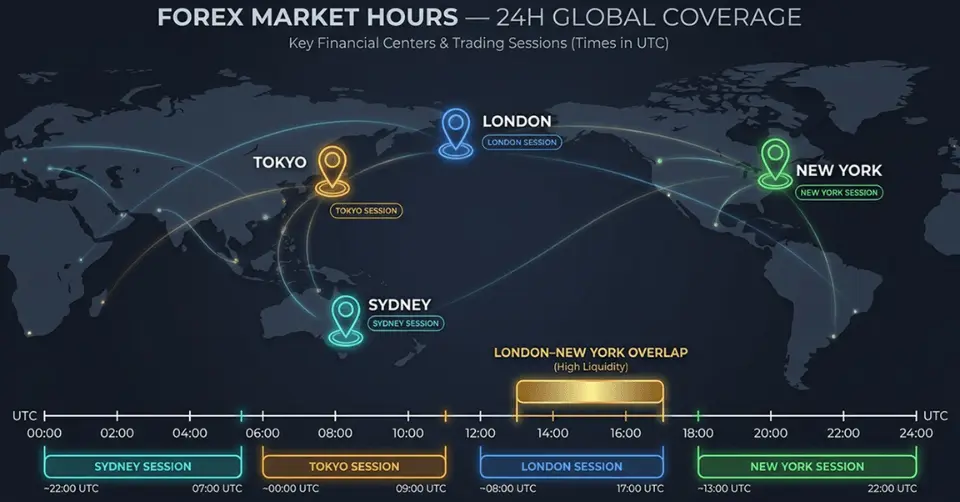
The forex market never closes. It runs 24 hours a day, five days a week, following the sun from one financial centre to the next. But not every hour is created equal. Understanding forex trading sessions — when they open, how they behave, and where the real opportunities sit — is one of the most underrated edges a trader can develop. While most beginners obsess over strategy, the professionals obsess over timing.
This guide breaks down every major forex trading session, what drives them, and exactly when you should — and should not — be at your desk.
What Are Forex Trading Sessions?
Forex trading sessions refer to the specific windows of the trading day when major global financial centres are actively open and processing transactions. Because currency markets are decentralised and operate across time zones, activity does not start and stop at a single bell. Instead, it shifts geographically as business hours move around the world.
The result is a market divided into four primary sessions: Sydney, Tokyo, London, and New York. Each session has a distinct character — different levels of liquidity, different currency pairs in focus, and different degrees of volatility. Knowing which session you are trading in is not just background knowledge; it directly affects your spreads, your risk, and your probability of a profitable outcome.
The Four Major Forex Trading Sessions
1. The Sydney Session (Asian Open)
Hours: 10:00 PM – 7:00 AM UTC
The Sydney session kicks off the trading week each Monday and re-opens the market after the weekend gap. It is the quietest of the four sessions in terms of volume, which means price movements are generally steadier and more measured. Liquidity is present, but the large institutional swings that characterise London and New York are largely absent.
Best currency pairs: AUD/USD, NZD/USD, AUD/NZD
For traders focused on the Australian or New Zealand dollar, this session is highly relevant. Commodity-linked economic data from the Asia-Pacific region — including Chinese trade figures and Australian employment releases — can generate sharp moves during these hours even when overall volume is low.
2. The Tokyo Session (Asian Peak)
Hours: 12:00 AM – 9:00 AM UTC
The Tokyo session represents the peak of Asian market activity and is where the majority of Asian session volume concentrates. During the Asian session, currency pairs involving the Japanese Yen (JPY), Australian Dollar (AUD), and New Zealand Dollar (NZD) tend to be most active — including USD/JPY, EUR/JPY, AUD/USD, and NZD/USD.
Best currency pairs: USD/JPY, EUR/JPY, AUD/USD
The Bank of Japan’s policy decisions, Japanese trade balance data, and broader regional risk sentiment drive movement during this window. In 2026, with the yen hovering near critical levels against the dollar, the Tokyo session has attracted heightened attention from macro traders watching for potential intervention signals from Japanese authorities.
3. The London Session (European Peak)
Hours: 8:00 AM – 5:00 PM UTC
The London session is, by a significant margin, the most important forex trading session in the world. Approximately 38% of all forex transactions happen during the London session, bringing significant volatility and setting the tone for the day ahead. London’s status as the historic heart of global currency trading means that institutional order flow, interbank transactions, and major investment fund activity all concentrate here.
Best currency pairs: EUR/USD, GBP/USD, EUR/GBP, USD/CHF
Spreads tighten dramatically when London opens. Liquidity surges. Price action becomes more directional and responsive to economic data. For most retail traders, the London session represents the single best window of the trading day — offering the combination of tight spreads, deep liquidity, and meaningful price movement that professional setups require.
ECB rate decisions, UK GDP releases, PMI surveys, and eurozone inflation data all land during this session, making it the primary battleground for fundamental traders.
4. The New York Session (North American Peak)
Hours: 1:00 PM – 10:00 PM UTC
The New York session is the second-largest in the world by volume and carries enormous significance for USD-denominated pairs. The New York session is the engine room of global forex trading — where more than $2 trillion shifts hands daily. US economic releases — including non-farm payrolls, CPI data, Fed minutes, and retail sales figures — are published during this window, regularly generating the sharpest single-candle moves of any session.
Best currency pairs: EUR/USD, GBP/USD, USD/JPY, USD/CAD
In 2026, Federal Reserve communication has become a dominant force during the New York session. With markets closely watching for any shift in the Fed’s “higher-for-longer” stance, every FOMC member speech and economic data point released during New York hours carries outsized market-moving potential.
The London–New York Overlap: The Most Powerful Window in Forex
If there is one period every serious forex trader should understand, it is the London–New York session overlap.
The overlap from approximately 8:00 AM to 12:00 PM EST is the most active and volatile period of the entire 24-hour cycle. Both the London and New York markets are open simultaneously, flooding the market with liquidity and creating the tightest spreads and the most significant opportunities.
During this four-hour window, European institutional players are in full flow while American banks are opening for business. The combined volume creates the conditions professional traders seek: maximum liquidity, minimum spread, and the highest probability of clean, directional price action. The best hours to trade forex are generally during the overlap of the London and New York sessions (12:00–16:00 UTC), as this period offers the highest liquidity and volatility, presenting more significant trading opportunities across major currency pairs.
For traders in 2026 navigating a market driven by oil-price inflation, central bank policy uncertainty, and US dollar strength, the overlap is also where macro narratives get tested in real time. When a Fed official speaks at 9:00 AM EST, the entire global institutional apparatus is watching and reacting simultaneously.
Forex Market Hours by Session: Quick Reference
| Session | Open (UTC) | Close (UTC) | Key Pairs | Character |
| Sydney | 10:00 PM | 07:00 AM | AUD/USD, NZD/USD | Quiet, steady |
| Tokyo | 12:00 AM | 09:00 AM | USD/JPY, EUR/JPY | Moderate, JPY-driven |
| London | 08:00 AM | 05:00 PM | EUR/USD, GBP/USD | High volume, directional |
| New York | 01:00 PM | 10:00 PM | EUR/USD, USD/JPY | News-driven, volatile |
| Overlap | 01:00 PM | 05:00 PM | All majors | Peak liquidity |
Note: Hours shift by one hour during daylight saving time changes in spring and autumn. Always verify session times against your broker’s platform.
Which Session Is Best for Your Trading Style?
The honest answer is that the best forex trading session depends entirely on your strategy, your time zone, and your risk tolerance.
Scalpers and day traders will find the London session and the London–New York overlap most rewarding — tight spreads and high volume create the conditions for rapid, repeatable setups. Swing traders monitoring macro trends can work across multiple sessions, using quieter Asian hours to plan and London–New York hours to execute. Beginners are often best served starting with the London session, where price action is most liquid and patterns are clearest.
What every trader should avoid is treating the market as equally tradeable at all hours. The Asian session, while valuable for JPY and AUD pairs, is a fundamentally different environment from the London open. Confusing the two — entering a breakout strategy during a low-liquidity Asian session, for example — is one of the most common and costly errors retail traders make.
Daylight Saving Time: The Hidden Variable
Daylight saving time shifts the opening and closing hours of forex sessions in UTC as different countries adjust their clocks. Traders must regularly check the current session times, especially in spring and autumn, to ensure their strategies are aligned with the correct market activity periods.
In 2026, the US and Europe shift their clocks at different times, creating a brief period each year where the London–New York overlap is an hour shorter than usual. This is a detail that costs unprepared traders meaningful opportunity every single year.
The Bottom Line
Mastering forex trading sessions is not about memorising a timetable. It is about understanding that the market has a rhythm — and that aligning your strategy with that rhythm is one of the clearest, most data-supported advantages available to any retail trader.
The London session offers depth. The New York session offers volatility. Their overlap offers both. The Asian sessions offer patience and precision on specific pairs. None of these windows is universally better than the others — but each demands a different approach.In a market as competitive and fast-moving as forex in 2026, the traders who know when to trade are already a step ahead of those who only know how.